
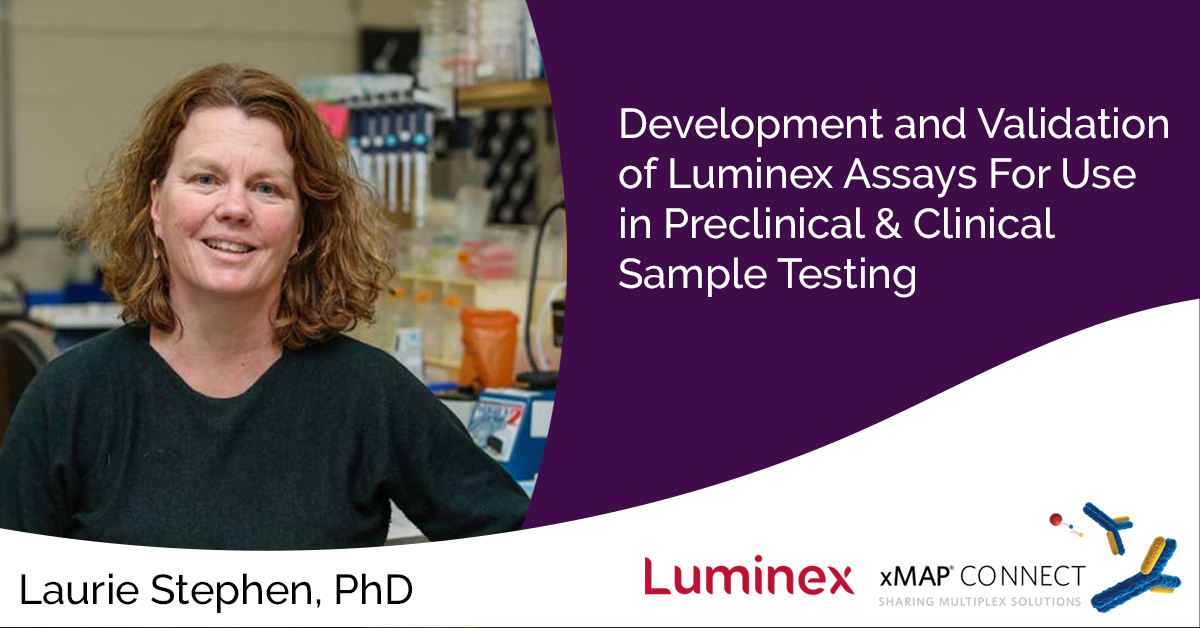
xMap Connect Conference Presentation by Ampersand Biosciences
Presenter:
Laurie Stephen, PhD President of Ampersand Biosciences
At the 2025 xMap Connect Virtual Series, Laurie Stephen, PhD. of Ampersand Biosciences shared insight on how to develop Luminex assays that provide reliable, reproducible, and meaningful results. As a small biotechnology company nestled in the heart of the Adirondacks, they have more room to explore Luminex assay development than larger companies. One of the top reasons to use Luminex technology is the cost efficiency per data point. After working on Multiplex kit development for the last 25 years, Ampersand Biosciences was able to stay at the forefront of innovation by recognizing the need to develop antibodies for models of underrepresented mammalians. In case you missed it, here are the key takeaways from the presentation, Development and Validation of Luminex Assays For Use in Preclinical and Clinical Sample Testing.
What Type of Luminex Instruments Should Be Used for Multiplexing Assays
Any Luminex instrument will work when it comes to developing multiplex assays. The beads themselves can be read on even the Luminex MagPix, which can handle roughly 50 analytes at a time uses the imaging read method. The Luminex 200 System is a flow-based system that is great for general use. It can handle up to around 100 analytes at a time. If you’re developing higher plexes, the Flexmap 3D can handle around 500 analytes and has faster read times but is also more expensive. For most of Ampersand Bio’s assays, they use the Luminex 200.
How to Develop Sandwich Assays on Luminex
Single Plex Assay Development with Traditional Monoclonal Antibodies
It is important to remember that with any assays you’re developing, they’ll only be as good as the quality of your antibodies. Whether you’re purchasing your antibodies from a vendor or developing your own, it is important to look for the highest quality.
Price is definitely a factor when selecting the right antibody vendor because of how much people will be willing to pay for the finished assay. If you find a good antibody, but it’s too expensive, you won’t be able to repeat the process of buying what your assay will rely on.
What really helps to determine quality is how the vendor validates the antibody. Validation processes vary from lab to lab. For example, at Ampersand Biosciences, we try to use monoclonal antibodies if it’s possible to do so. If polyclonal detection is used, we try to make it in-house so that every polyclonal detection is the same lot to lot. That helps produce the most reliable, reproducible results.
If you do have to purchase antibodies from a vendor, the size of the company doesn’t necessarily guarantee quality. Small companies out there do a lot of good work. What is the most important marker for quality is if that company’s antibody has been used to pick up a real sample, not just recombinant protein.
When developing monoclonal antibodies, Luminex makes it easy to include a negative control sample that helps weed out any non-specific antibodies. This helps find potential great clones of your monoclonal antibodies to move forward with into multiplex assay development.
Multiplex Assay Development
In developing multiplex assays, it’s always important to include positive real samples. After growing the best clones, purifying them, and performing a checkerboard assay to determine the best pairs, it’s time to multiplex. One of the nice things about Luminex is that it can conjugate all these antibodies to different beads and multiplex them together to save loads of time.
The process is the same for all antibodies developed at Ampersand Biosciences when they’re ready for multiplexing. The approach they take is a bit of a shotgun approach, where all the beads are added and all the detections and standards to see where they’re at. Generally, the standards are set at the level that worked in the single plex assay. The detections are then added at 1mg per ml. Then each standard is added on its own to determine if there will be any problems.
Examples of multiplex assays developed by Ampersand Biosciences:
- Ferret Cytokine Panel 2 – Luminex 13 plex
- Hamster Cytokine Panel 1 – Luminex 9 plex
- Pick a Plex Hamster Cytokine Luminex 17-Plex
- Porcine Cytokine Panel 1 – Luminex 9 plex
- Rat High Sensitivity Cytokine Panel 1 – Luminex 13 plex
- Mouse Cytokine Panel 1 – Luminex 13 plex
- Mouse Cytokine Panel 2 – Luminex 11 plex
How Multiplex Validation works on Luminex
Once everything is packaged, it’s time for assay validation. Each lab needs to determine the level of validation needed for its purpose. How assay validation is done at Ampersand Bioscience is that they first determine the Lower Limit of Detection (LDD) by testing 20 replicas of the standard curved diluent plus 2SD , and calculate it back to the curve. LOQ is determined by diluting positive samples and looking for where linearity and precision are still acceptable. No samples are reported above the ULOQ, but are instead retested at a higher dilution.
Precision is determined through observation of serum-based controls using different used on different days with different instruments.
Linearity can be observed through both serum and plasma samples to determine if sample linearity what dilution is reproducible
Sample Stability is done to make sure that when samples are tested that there won’t be any degradation when added to the plate. Samples are typically on ice when the assay is developed and no issues have occurred. Occasionally, an analyte doesn’t like room temperature, but typically they are pretty stable at 4C.
Freeze Thaw Stability is a crucial step in the process. When you’re collecting samples, you should put them in several different vials to store at -80C for good stability. The number of freeze thaw and your conditions for bench stop stability should reflect your lab process.
Standard XRT is the next phase. If everything is acceptable, the final standard and detection crossreactivity is repeated. Standard XRT is critical to do in multiplex assays. Each standard is observed singly in multiplex detection to make sure the beads are not picking up anything other than what they’re supposed to. This should be repeated if you change vendors and also for each new lot of polyclonal detection.
Detection XRT is performed after Standard XRT. For detection cross-reactivity, multiplex bead and single detections are added. It’s critical to look at positive samples as you may find that your assay doesn’t react with the recombinant but it does with a native protein. Like standard XRT, detection XRT should be performed with each new lot of polyclonal detection.
Benchmarking is the final step in the process. The best case scenario is that there are reference samples are available, but for cytokines, this can be tricky. There are no reference samples for cytokine concentration, just activity. Cytokine concentrations are variable from assay to assay and from one company to the next. Because there is no gold standard when it comes to cytokines, it’s important to generate your own real samples either from disease state or through simulating PBMCs for cytokines to spike them into serums. It is also possible to compare ELISA references or other multiplexes. If all else fails, literate values can help determine if you’re in the right range with your values.
Luminex Sample Testing Best Practices
Why it’s important to run standards with every plate
Sample testing is the whole reason that assays are developed. But if the plate is not set up properly or standards are not run on every plate, certain issues may arise. One such issue is a front-to-back issue which can be common in sandwich immunoassays. It is very important to have your standards at the beginning and end of the plate to make sure that your samples are the same throughout the plate.
Another reason it’s important to run standards with every plate is inter-assay precision. MFIs can be different from run to run. This can be due to daily temperature changes in the lab, slight differences in incubation time, different shakers or different instruments.
Serological Assays vs. Sandwich Assays on Luminex
Sandwich assays are where the capture antibody is conjugated to the bead. You add to your sample your standard, come back with another biotinylated detection to the same protein and analyze it with a Luminex instrument. This is not the case for Serological Assays. Serological assays are where your protein of interest is conjugated to the bead before you add your sample. The antibodies in your sample should bind to your protein of interest. Then, when another antibody is added, it is easy to observe how much the antibody has bound to the bead. The nice thing about serological assays is that they have a fairly high sample dilution so there is no need to worry about the matrix effect. This also makes it really easy to multiplex a large number of antigens.
The matrix effect refers to the loss of analyte signal due to the presence of other components in a sample matrix such as serum, or plasma This effect can lead to inaccuracies in analytical measurements as it affects the signal of the specific compound (analyte) being analyzed. Understanding and quantifying the matrix effect is crucial for ensuring the reliability of analytic assays.
An example of a serological assay that was developed by Ampersand Biosciences is the Flavivirus panel. To learn more about it, click here.
Special Storage and Stability Issues for Multiplex Assays
Besides the beads and the buffers, everything in the Luminex kits created by Ampersand Biosciences is freeze-dried. All kits are shipped at room temperature, which helps save a lot of money on shipping cost which is then passed down to those who buy the kits. Because certain countries, labs, and transports may not have the ability to keep kits at a certain temperature, it is important that a kit can be stable at room temperature.
Leave a Reply
Want to join the discussion?Feel free to contribute!