
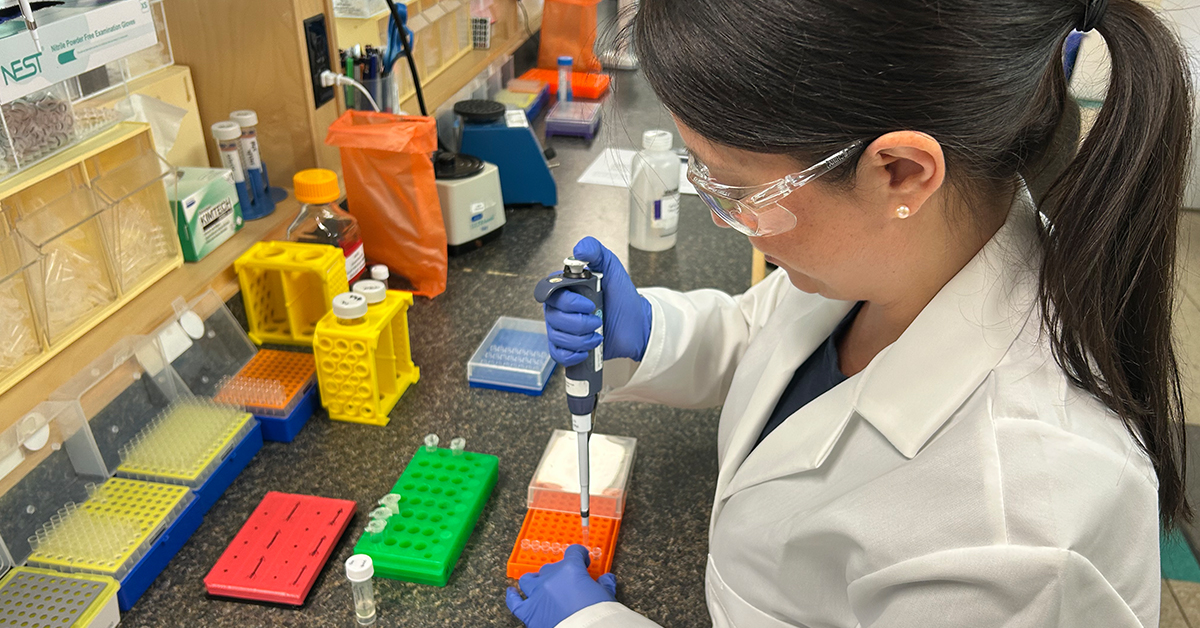
Developing Luminex Multiplex Serological Assays for Mosquito-Borne Viruses & Flavivirus
In recent years, the study of Arboviral diseases have become a major growing field of study driven by very practical realities. Mosquito borne illnesses are expanding geographically due to urbanization, global travel, and climate shifts. Regions that once rarely encountered such viruses are now experiencing seasonal transmission.
Because of this, Ampersand Biosciences has begun to focus on multiplex serological assays for flaviviruses such as Dengue virus, Zika virus, Yellow Fever virus, Chikungunya virus, while also adding in viruses to their panels that are found more locally. Let’s dive into the differences between traditional sandwich assays and serological assays and what that may mean for your research on flaviviruses.
Sandwich Assays vs. Serological Assays: Key Differences in Immunoassay Design and Applications
When developing sandwich assays, the capture antibody is first immobilized then conjugated to a magnetic bead or a multiplex bead for systems like Luminex. The antibody is engineered to bind specifically to the antigen that you want to detect. Then, you add your sample to your standard, come back with another biotinylated detection to the same protein and SAP (Streptavidin-Alkaline Phosphatase). Finally, you analyze it with a Luminex instrument.
The process is a bit different for serological assays. To start, your protein of interest is conjugated to the bead. Then, you add your sample. Your sample should bind to your protein of interest. After this happens, you come back with another antibody, which depends on the species you’re looking at, and see how much that antibody has bound to the bead. The secondary antibody can be biotinylated or directly conjugated to the SAP and that saves a step. The nice thing about serological assays is that they usually have a fairly high sample dilution. This means you don’t have to worry too much about the matrix effect. Another benefit is that it’s really easy to multiplex a large number of antigens.
The Matrix effect refers to the loss of analyte signal due to the presence of other components in a sample matrix such as food, urine, plasma, or blood. This effect can lead to inaccuracies in analytical measurements as it affects the signal of the specific analyte being analyzed. Because serological assays have a fairly high sample dilution, they produce more reliable analytic assays, keeping the analyte signal from becoming lost.
As you increase antigen concentration, your signal increases. At some point it will reach a plateau and that is usually where you want to be. However, sometimes when you’re multiplexing antigens you might have some that are more reactive than others. If this happens, you might end up using a lower concentration of the more reactive antigen and a higher concentration of less reactive antigen so you can use the same dilution of the serum sample.
Serological assays can easily be adapted to Luminex and allows for testing of multiple antigens at once to give a comprehensive picture of the immune response. With this in mind, Ampersand Biosciences launched their Flavivirus Serological Panel for Luminex in 2025.
Importance of Serological Assay Development for Flaviviruses and Alphaviruses
Years ago, Ampersand Biosciences worked with a client to develop serological assays for Zika testing. Recently some cases have been seen in the United States. One of the worst things about the Zika virus is that it can cause microencephaly and other birth defects so it is scary for pregnant women all over the world. Zika causes fever, rash, and joint pain. It is very similar to the symptoms of Dengue and Dengue virus can be seen in similar locations. With global warming, Zika and Dengue may become more prevalent in the United States.
Zika virus, Dengue virus, Chikungunya virus, and Yellow Fever are all transported by the Aedes species of mosquito which are not mosquitos that we have in the United States as they tend to be more tropical. Whereas other viruses like West Nile Virus, St. Louis Encephalitis Virus, and Japanese Encephalitis Virus are transported by the Culex species which we do have here in the United States and you can’t avoid them.
Developing the new Human/Mouse Flaviviruses Serological Assay Panel 14-plex
In the Human/Mouse Flaviviruses Serological Panel 1-3 Luminex 14-Plex, the following tropical viruses were observed: Chikunya virus, dengue virus, zika virus, and yellow fever.
- Chikunya virus – We coupled recombinant envelope protein for chikungunya virus.
- Dengue virus – There are four strains of dengue virus and for two of the strains we coupled the NS1 protein and the other two strains, the VLP (virus like particle, a protein minus the infection ability).
- Zika virus – For the Zika Virus we coupled both the VLP and the NS1 protein.
- Yellow Fever – For Yellow Fever, we coupled the NS1 protein and the envelope protein.
Standards and controls were designed using different serums and antibodies to express the results as relative units. This allows results to be compared over time between plates and new kit lots.
Four viruses were added to the panel to include mosquito transmitted viruses that were found more locally to the United States.
- Japanese Encephalitis Virus – We coupled antigens to Japanese encephalitis virus NS1
- St. Louis Encephalitis Virus – We coupled antigens to St. Louis encephalitis virus NS1
- Equine Encephalitis Protein Virus – We coupled antigens to the Equine Encephalitis Protein Virus that we made here in a CE2A3 to part of the protein.
- West Nile Virus – we coupled antigens to West Nile Virus including the NS1 antigen and the envelope protein which we also made here.
Several of these viruses are also flaviviruses and some of them are alphaviruses. The thing with the encephalitis viruses is they’re a lot more deadly.
Flavivirus Structure
They share common aspects
- Common size – they’re about 40 – 65 nanometers
- Same symmetry
- The envelope protein – the nucleocapsid
- They are single stranded RNA
- They are around 10,000 – 11,000 base pairs
Serum samples from Boca Biolistics were purchased to look at Chikunya positive samples. All of the samples reacted to the Chikunya antigen but they also reacted to all of the Dengue Virus antigens, West Nile Virus envelope protein, and the JEV-NS1. So there’s a good chance that all the samples were also Zika Virus and Dengue Virus positive as they were obtained from Central America where Zika and Dengue are very prevalent.
Dengue positive samples were observed next. They were very reactive for Dengue antigens and a few other of the antigens that were similar to Chikunya samples. It’s possible that these individuals also had Yellow Fever and Zika. It could be cross-reactive. There’s no real way of knowing but they were in areas where they are endemic. It’s less likely that they were exposed to other flaviviruses like West Nile Virus so there’s likely a lot of cross-reactivity amongst the flaviviruses. It’s really hard to know how that affects immunity but it’s important to understand.
With the Zika positive samples there was good reactivity to the Zika antigens and similar trends with Dengue. But again, these samples are from Central America so they were likely exposed to Chikunya and Dengue and Yellow Fever. It’s really hard to get samples that we are sure haven’t been exposed or it’s hard to know what they’ve been exposed to in a lifetime.
West Nile Virus samples were obtained from the United States and observed. They were pretty specific for the envelope protein and to a certain extent the NS1 protein where reactivity was seen to occur.
It’s really important to look at more than one thing because if you have someone who is positive for Dengue Virus in the past and you’re just looking at West Nile Virus, it might seem like they have West Nile reactivity when really it’s just cross-reactivity. But again, who knows, maybe they’re still okay.
Lastly, normal samples were sought out to see what could be considered a negative flavivirus sample. Pediatric samples were added since they have less of a chance of being on a tropical vacation or exposed to multiple viruses. Although, it’s possible there is some maternal transmission of the antibodies. This helped establish a baseline for the most part. The normal and west nile serums had a low reactivity to the flaviviruses.
Mouse Responses After Injection with ZIKA PRVABC59
Whereas it’s difficult to know where humans have been, we can track mice. Serum samples were obtained from the Trudeau Institute from one of their studies where they infected mice with the Zika antigen. These were used to look at cross-reactivity amongst the flaviviruses. Good reactivity was observed among the Zika antigens. Dengue VLPs and the West Nile envelope have a pretty strong reaction. A little bit of reactivity was observed with the JEV-NS1 (Japanese Encephalitis Virus).
This shows that infection with Zika will potentially have some protective effect against these other diseases. It’s really hard to know but it’s important to understand how infection with one virus affects immunity of the other viruses and there’s definitely a lot of studies looking at that.
Stability at Room Temp
One great thing about testing antibodies is they’re incredibly stable. Stability of the serum samples was monitored over 14 days at room temperature and there was no loss of signal. It’s nice to know that if you’re in an environment where you don’t have refrigeration and you collect a sample that it’s pretty stable and you can still test.
Correlations of IgG signal +/- Heat Inactivation
Heat treatment was performed at 56 degrees Celsius for 30 minutes which should kill any live virus and allow you to ship samples without any worry. There were excellent correlations, no sample breakdown at all. It’s a good way of treating your samples and not worrying about any kind of change.
Correlative Protection with Serological Assays
Often when you get into vaccine programs they look at something called correlative protection. Correlate of protection refers to a measurable immune marker that predicts whether a person is protected from infection or disease. This is the biological indicator that signals that the immune system is prepared to resist a pathogen.
Determining which parts of the population that are susceptible to a specific flavivirus disease is difficult because they may already have preexisting antibodies for a number of them. Researchers have been known to use a titer on certain serum samples. What’s important to have with serological assays is some form of either reference standard or reference control so you’re always comparing apples to apples. That increases confidence in the assay, knowing that three years from now when the same kit is being developed, if a signal changes slightly, there is a reference standard.
Expanding the Flavivirus Panel
There are many different viruses in the Flavivirus Serological panel already, but there have been requests to expand it for malaria, parasites, and other types of viruses. A group that Ampersand Biosciences is working with have been working with are interested in expanding the panel. So hopefully that works out, that more could be done, because it’s so powerful and you can see how important it is to look at different antigens. If you look at tick born illnesses, there’s a lot of work going on there as well and Luminex has a lot of potential for really doing a good job with that.
Ampersand Biosciences is hoping to get more serological assays because they are so powerful to work with people. There is a lot of demand for more of the brain markers in animal models, so these are being looked into, specifically traumatic brain injury (TBI). There’s a lot of research going into TBI with different animal models. Also, potentially metabolic GLP analogs and how they function.
Please reach out if you have flavivirus samples, Ampersand Biosciences would love to work with you and understand them better, together.
Leave a Reply
Want to join the discussion?Feel free to contribute!