
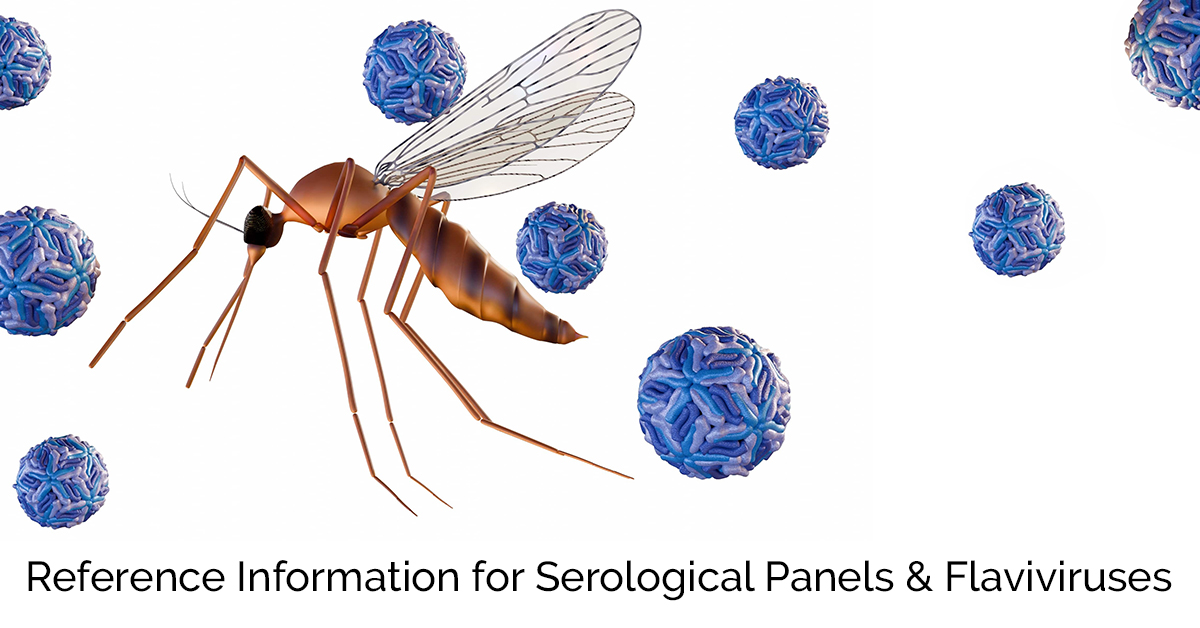
Reference Information for Serological Panels & Flaviviruses
Luminex has a lot of potential to expand our serological panels. Currently we cover Zika, Chikungunya Virus, Dengue Virus, Yellow Fever Virus, Japanese Encephalitis Virus, St. Louis Encephalitis Virus, Equine Encephalitis Virus, and West Nile Virus. As we expand, we will add information here.
Last updated: 3/17/2026
Zika Virus
- Description: Zika is a mosquito-borne virus that causes febrile illness, which is especially dangerous in fetal development during pregnancy.
- Classification: Flavivirus in the family Flaviviridase which is the same viral group that includes Dengue virus, West Nile virus, and Yellow Fever virus.
- Symptoms: Most infections are asymptomatic and many of its symptoms overlap with other mosquito-borne illnesses which leads to the need for laboratory testing to distinguish Zika from related infections.
- Transmission: Zika is transmitted by Aedes mosquitos, especially Aedes aegypti and Aedes albopictus.
- Region: Central and South America, Caribbean nations, Sub-Saharan Africa, South and Southeast Asia, and Pacific island regions.
- Serological Panel: Pick-a-Plex IGG Flaviviruses 14 Plex
Chikunya Virus
- Description: Chikungunya is a mosquito-borne virus that causes febrile illness known as chikungunya disease.
- Classification: Chikungunya is considered an alphavirus in the family Togaviridase, which places it in a different viral lineage than flaviviruses such as Dengue or Zika. However, it circulates many of the same regions as flaviviruses like Dengue Virus, Zika Virus, and Yellow Fever Virus.
- Symptoms: Intense joint pain.
- Transmission: Chikungunya is transmitted by Aedes mosquitos, particularly Aedes aegypti and Aedes albopictus.
- Region: Parts of southern United States during limited outbreaks, Central and South America, Caribbean nations, Sub-Saharan Africa, South and Southeast Asia, and the Indian Ocean region.
- Serological Panel: Pick-a-Plex IGG Flaviviruses 14 Plex
Dengue Virus
- Description: Dengue is a mosquito-borne virus that causes dengue fever which is one of the most widespread viral diseases transmitted by insects.
- Classification: Dengue is considered a Flavivirus in the family Flaviviridase which is the same viral group that includes Zika virus, West Nile virus, and Yellow Fever virus.
- Symptoms: Sudden high fever accompanied by joint pain, headache, nausea, and rash.
- Transmission: Dengue is transmitted by Aedes mosquitos, especially Aedes aegypti.
- Region: Central and South America, Caribbean nations, Sub-Saharan Africa, South and Southeast Asia, and parts of the Western Pacific including islands and northern Australia.
- Serological Panel: Pick-a-Plex IGG Flaviviruses 14 Plex
Yellow Fever Virus
- Description: Yellow Fever is a mosquito-borne virus that causes yellow fever.
- Classification: Yellow Fever belongs to the Flavivirus genus within the Flaviviridae family which is the same viral group that includes Zika virus, West Nile virus, and Dengue virus.
- Symptoms: Fever, liver damage, and in some cases international bleeding. It presents as jaundice, fever, headache, muscle pain, nausea, and fatigue and is considered severe.
- Transmission: Yellow Fever is transmitted by Aedes mosquitos in urban settings and other mosquito genera in forest environments.
- Region: Tropical regions of Africa and South America.
- Serological Panel: Pick-a-Plex IGG Flaviviruses 14 Plex
Japanese Encephalitis Virus
- Description: Japanese Encephalitis is a mosquito-borne virus that causes Japanese encephalitis in the brain.
- Classification: Japanese Encephalitis belongs to the Flavivirus genus within the Flaviviridae family which is the same viral group that includes Zika virus, West Nile virus, Yellow Fever virus, and Dengue virus.
- Symptoms: Roughly 99% of people infected with JEV show no symptoms or only mild illness. When disease does occur, however, it can be severe. Symptoms typically begin with fever, headache, vomiting and progression to inflammation of the brain which can involve seizures, neurological damage, or coma.
- Transmission: JEV is transmitted by Culex mosquitos, especially Culex tritaeniorhynchus.
- Region: South Asia, Southeast Asia, East Asia, and Western Pacific regions such as Papua New Guinea and northern Australia.
- Serological Panel: Pick-a-Plex IGG Flaviviruses 14 Plex
St. Louis Encephalitis Virus
- Description: St. Louis Encephalitis is a mosquito-borne virus that causes St. Louis encephalitis, a neurological disease characterized by inflammation of the brain. Severe disease is uncommon but can be life-threatening in older adults.
- Classification: St. Louis Encephalitis belongs to the Flavivirus genus within the Flaviviridae family which is the same viral group that includes Zika virus, West Nile virus, Yellow Fever virus, and Dengue virus.
- Symptoms: Most infections produce no symptoms or only mild illness. Mild symptoms are fever, headache, and fatigue. Severe symptoms are confusion, tremors, seizures, or coma.
- Transmission: SLEV is transmitted by Culex mosquitos, especially Culex tritaeniorhynchus.
- Region: North America, Central America, Caribbean regions, and parts of South America including Mexico, Brazil, Argentina, and Peru.
- Serological Panel: Pick-a-Plex IGG Flaviviruses 14 Plex
Equine Encephalitis Virus
- Description: Equine Encephalitis viruses are a group of mosquito-borne viruses that can cause inflammation of the brain in both humans and horses. These include: Eastern Equine Encephalitis Virus (EEEV), Western Equine Encephalitis Virus (WEEV), and Venezuelan Equine Encephalitis Virus (VEEV). All three circle in nature through mosquito transmission cycles but have slightly different geographic distributions and ecological hosts.
- Classification: Equine Encephalitis viruses belong to the genus Alphavirus in the family Togaviridae, which places them in the same broader viral group as Chikungunya virus.
- Symptoms: Most infections produce no symptoms or only mild illness. Mild symptoms are fever, headache, and fatigue. Severe symptoms are confusion, tremors, seizures, or coma.
- Transmission: Depending on the Equine Encephalitis virus, the primary vectors are Culiseta Melanura for EEEV, Culex tarsalis for WEEV, and Culex mosquitos for VEEV.
- Region: North America, Gulf Coast, Caribbean regions, Central America, and South America.
- Serological Panel: Pick-a-Plex IGG Flaviviruses 14 Plex
West Nile Virus
- Description: West Nile is a mosquito-borne virus that can cause illness ranging from mild fever to severe neurological disease. Serious conditions usually occur in older adults or people with weakened immune systems.
- Classification: West Nile belongs to the Flavivirus genus within the Flaviviridae family which is the same viral group that includes Zika virus, West Nile virus, Yellow Fever virus, and Dengue virus.
- Symptoms: Most infections produce no symptoms. Mild symptoms include fever, headache, body aches, fatigue, and sometimes a rash. Severe conditions can cause meningitis or encephalitis.
- Transmission: WNV is transmitted by Culex mosquitos.
- Region: Africa, Europe, Middle East, Asia, North America.
- Serological Panel: Pick-a-Plex IGG Flaviviruses 14 Plex
Leave a Reply
Want to join the discussion?Feel free to contribute!